The Ainsworth Di Hedral — Blade Design
A complete guide to what this paddle does for you — and the engineering behind why it works.
The Blade That Changed Paddling
380 g / 84 sq in blade, 70 in long. Zero flutter. Built beyond autoclave standards.
In 1987, Andrew Ainsworth created the dihedral blade for his K100 kayak paddle — the first of its kind. He brought an unusual combination of disciplines to the problem: three years of engineering training followed by three years of industrial design. As an engineer he understood materials, forces and manufacturing; as a designer he understood form, function and the relationship between them. Most paddle makers were one or the other. Andrew was both.
At the time, every kayak paddle on the market used a shallow spoon. It caught water well enough, but it had a fundamental flaw: flutter. Paddlers were forced to actively manage the blade on every stroke, fighting instability instead of putting power down. Energy that should have gone forward was being burned off keeping the blade in line.
Andrew's answer was the Di Hedral.
The K100 became one of the most successful kayak paddles ever made — in production for nearly thirty years, the paddle a whole generation of racers learned with. Its run only ended when changes to EU materials and manufacturing regulations made it impossible to keep building. The design was never superseded. It simply stopped being legal to make.
The Di Hedral SUP paddle carries that work forward: the same blade geometry, the same philosophy, the same construction principles that earned the K100 thirty years of trust.
How It Works — And What You Feel
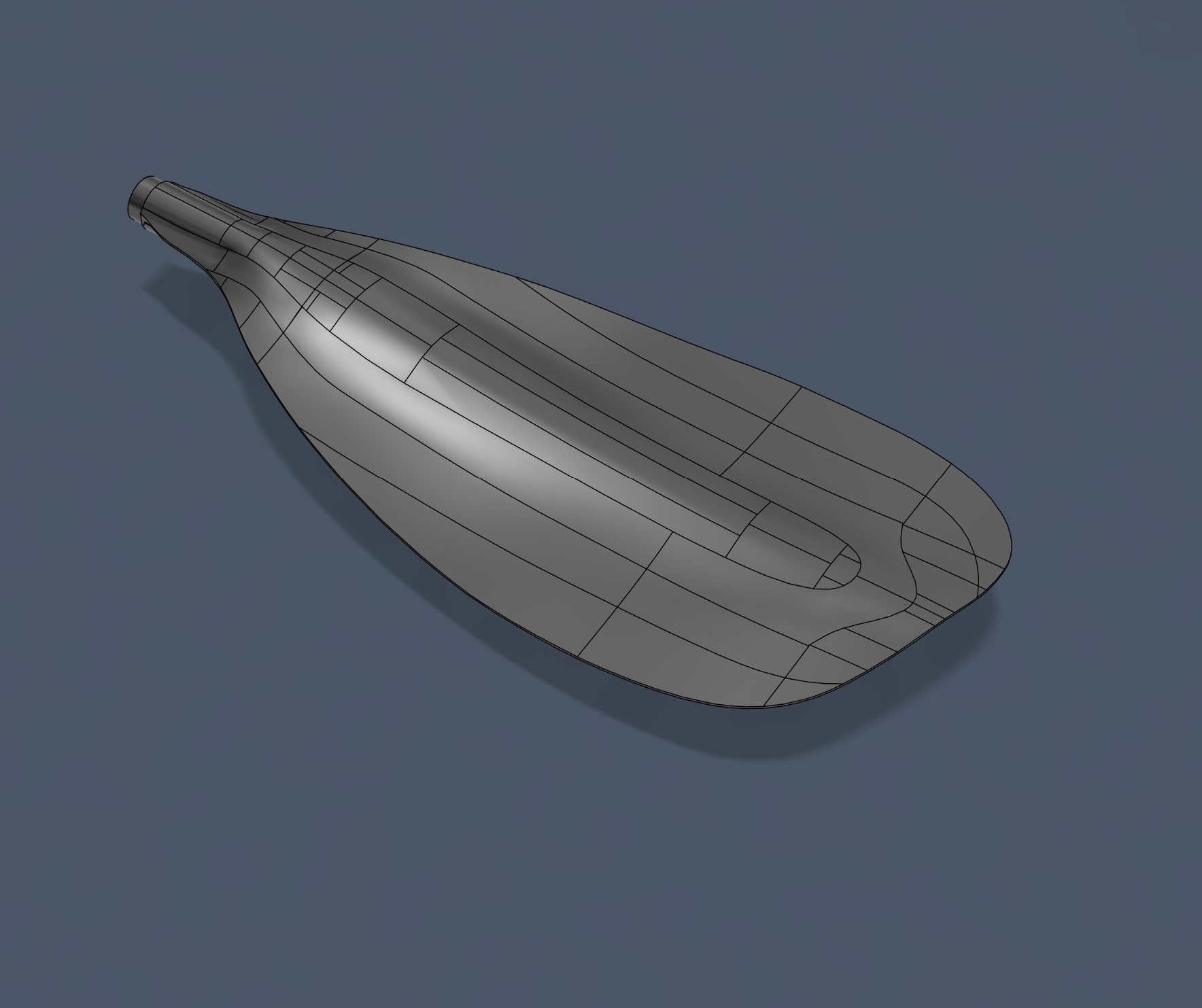
A raised central ridge runs down the face of the blade, dividing it into two symmetrical spoon-shaped panels. This is the dihedral — two planes meeting at a gentle, carefully calculated angle.
The effect is immediate. Where a flat or shallow-spoon blade flutters mid-stroke, the Di Hedral self-stabilises like a pendulum finding its centre. The ridge splits water flow evenly to each side with no input from you. Zero flutter. You stop fighting the blade and start using it — every joule you put in goes forward.
The Di Hedral isn't a choice between dihedral geometry and a spoon — it's both, working together. Each half of the face is itself a spoon, shaped to grip and hold water through the power phase. The ridge delivers stability; the spoons deliver power. The catch loads instantly, and the blade holds the water cleanly all the way to the exit.
The exit matters too. A poorly shaped ridge creates drag and turbulence as the blade leaves the water, robbing you of momentum at the end of every stroke. The Di Hedral avoids this because of how the peak is shaped — not a hard edge, not a computer-generated profile. Andrew sculpts the peak by hand: a soft, flowing transition refined over four decades of feel and observation. No algorithm produces this shape. It exists because Andrew's hands know where the water needs to go.
Every paddler benefits. Beginners gain control they would otherwise spend years developing. Experienced paddlers convert more effort into forward motion, with less energy lost at every phase of the stroke. Over a long session or a race distance, the cumulative difference is significant.
Designed by Nature — Validated by Aviation
Look at the cross-section of a bird in glide. Look at the wings of an aircraft. Both share the same geometry: two surfaces angled upward from a central point, smooth curves, no sharp edges. This is the dihedral — and it exists in nature and engineering for one reason: passive stability in a fluid medium.
In aviation, dihedral wing geometry gives aircraft inherent roll stability. When one wing dips, the angle automatically corrects the imbalance — no pilot input required. A bird does the same thing instinctively. The forces rebalance themselves, like a pendulum returning to centre.
Andrew applied that principle to a paddle blade in 1987. The cross-section of the Di Hedral face mirrors the cross-section of a wing: a gentle bilateral rise from the centre, symmetrical, smooth, self-stabilising in water. The geometry corrects itself on every stroke, just as a wing holds its line in the air. You get the benefit automatically, from the first stroke.
This is why the Ainsworth ridge is a smooth, gradual rise — not a sharp rib. Competitors such as Black Project's Nemesis use a hard central spine. No bird has sharp edges. No wing has a knife down its centre. Andrew considers this a fundamental misunderstanding of fluid dynamics. Nature and aerospace engineering solved the problem long ago; the Di Hedral simply follows their lead.
The Industry Is Still Catching Up
In 1987 the dihedral blade was entirely new. Nearly four decades later, most SUP paddles still use a flat blade face — forfeiting the stability and efficiency advantages Andrew identified from the beginning.
A handful of manufacturers have recently started exploring dihedral geometry, but only in very shallow form — a tentative first step toward a principle Ainsworth has spent decades refining. A shallow dihedral delivers a fraction of the stabilising effect. The Di Hedral is the full expression of the idea: a carefully calculated ridge depth, tested across flatwater racing, SUP touring and whitewater rivers.
Being copied, even partially, is the sincerest form of validation.
Construction: Built Beyond Autoclave Standards
The Di Hedral blade is built from carbon fibre and Innegra, combined across multiple pre-preg laminates and press-moulded under up to 10 tons of pressure.
What that means for you: no hidden weak points, no compromise in stiffness, no energy lost to flex that shouldn't be there.
Carbon composite strength comes down to one thing — how completely the epoxy resin surrounds every individual carbon fibre. Inadequate penetration leaves voids: hidden weak points that rob the blade of stiffness and eventually lead to failure. Ainsworth uses 3k carbon (3,000 fibres per tow), and the 10-ton press forces resin into every gap with a consistency no other method can match.
Wet lamination can't achieve this level of penetration. Even autoclave construction — widely considered the gold standard — is limited by physics: it can only exert the pressure of a full vacuum, 14.7 lb/sq in. The Ainsworth press mould operates at a different order of magnitude entirely. What comes out is denser, stiffer and more consistent than any autoclave can produce.
380 g / 84 sq in blade, 70 in long — among the lightest SUP paddles in the world. Serious surface area, almost no weight penalty — stroke after stroke, mile after mile.
The Knife-Edge Catch
There's another consequence of this construction method that no foam-blank paddle can replicate: the tip of the Di Hedral is just 1.4 mm thick.
Most competing paddles — including those from Black Project and Starboard — are built around a foam core with carbon laminate bonded to each face. The foam dictates the minimum tip thickness. No matter how good the carbon skin, the edge entering the water is blunt and wide. You're pushing resistance before the stroke has begun. Andrew calls it pushing a lollipop into the water — and the comparison is apt.
The Di Hedral enters the water like a knife. The 1.4 mm tip slices through the surface cleanly, so the full power phase begins from the first moment of the catch. Every fraction of your effort goes into the stroke — none is squandered on a clumsy entry. In racing and performance SUP, where the catch is everything, this is the difference that decides outcomes.
Innegra: Edge Durability That Protects Your Investment
Carbon fibre is extraordinarily stiff — but also brittle. In whitewater and rocky river conditions, a pure carbon edge will chip and crack on impact, and once the edge is damaged the blade's structure and performance both start to fail.
Ainsworth addresses this by weaving Innegra cloth across multiple pre-preg laminates in the layup. Innegra is a high-performance polypropylene fibre with outstanding impact resistance and vibration-damping properties. Where carbon resists, Innegra absorbs. The combination is a blade that is both maximally stiff and significantly more durable at the edge than any pure carbon construction — one that holds its performance session after session, year after year.
Real-world testing has been extensive and unforgiving. Cameron Hopkins (@choppysup) has run Ainsworth blades hard on rocky Scottish rivers; Caroline at SUPLASS (suplass.com) has put them through Welsh whitewater; and Zach Bassett of Bassett Adventure (@elevate_outdoors), who runs international paddling expeditions, has tested them across environments worldwide — his review is at youtu.be/zrGQi-umkJY. The verdict is consistent: the Di Hedral's Innegra construction holds up where others chip and degrade.
One Paddle, One Flex — Tip to Tip
Most paddle manufacturers treat the blade and shaft as separate components joined at the neck. Energy transfer between them is always imperfect — a dead spot, a stiffness, an energy loss at the junction.
Andrew designed the blade and shaft as a single unified system. The back face of the Di Hedral carries a soft, shaped, ultra-lightweight foam rib — not structural foam, but a carefully profiled rib that acts as a direct extension of the biaxial carbon construction of the shaft. The paddle flexes as one continuous unit, from the tip of the handle to the tip of the blade. Power feeds smoothly through the whole paddle on every stroke. Nothing is lost at the join.
In practice, that means less fatigue at high stroke rates over long distances. A paddle that flexes as a whole absorbs and returns energy more naturally, reducing joint strain and helping you sustain output mile after mile.
The Crankshaft — Energy Saved, Injury Prevented, Performance Unlocked
One last design element turns the Di Hedral from an exceptional blade into an exceptional paddle: the crankshaft.
Andrew's shaft incorporates a deliberate bend — a crank — engineered to hold the paddling hand in a naturally ergonomic position throughout the stroke. The benefit is felt most acutely at the catch, where a straight shaft forces the wrist into an unnatural angle at the moment of highest load. Every stroke adds to that accumulated stress. Wrist pain, forearm fatigue and shoulder strain are among the most common complaints in SUP paddling — and on a straight shaft, they're almost inevitable over time.
The crankshaft removes the root cause. By aligning the hand correctly at the catch, it strips out the torque that would otherwise travel up the arm on every stroke. Muscles that were bracing against discomfort are free to paddle. Energy that was being burned compensating for an unnatural position now goes forward. Distance paddling becomes easier. Long sessions stop taking their toll on your body the way they used to.
The performance benefit follows directly. Once you're no longer managing discomfort, you can commit to a larger blade area — more surface, more power per stroke, better efficiency across every mile. The crankshaft doesn't just protect the body. It unlocks a level of performance a straight shaft physically prevents you from reaching.
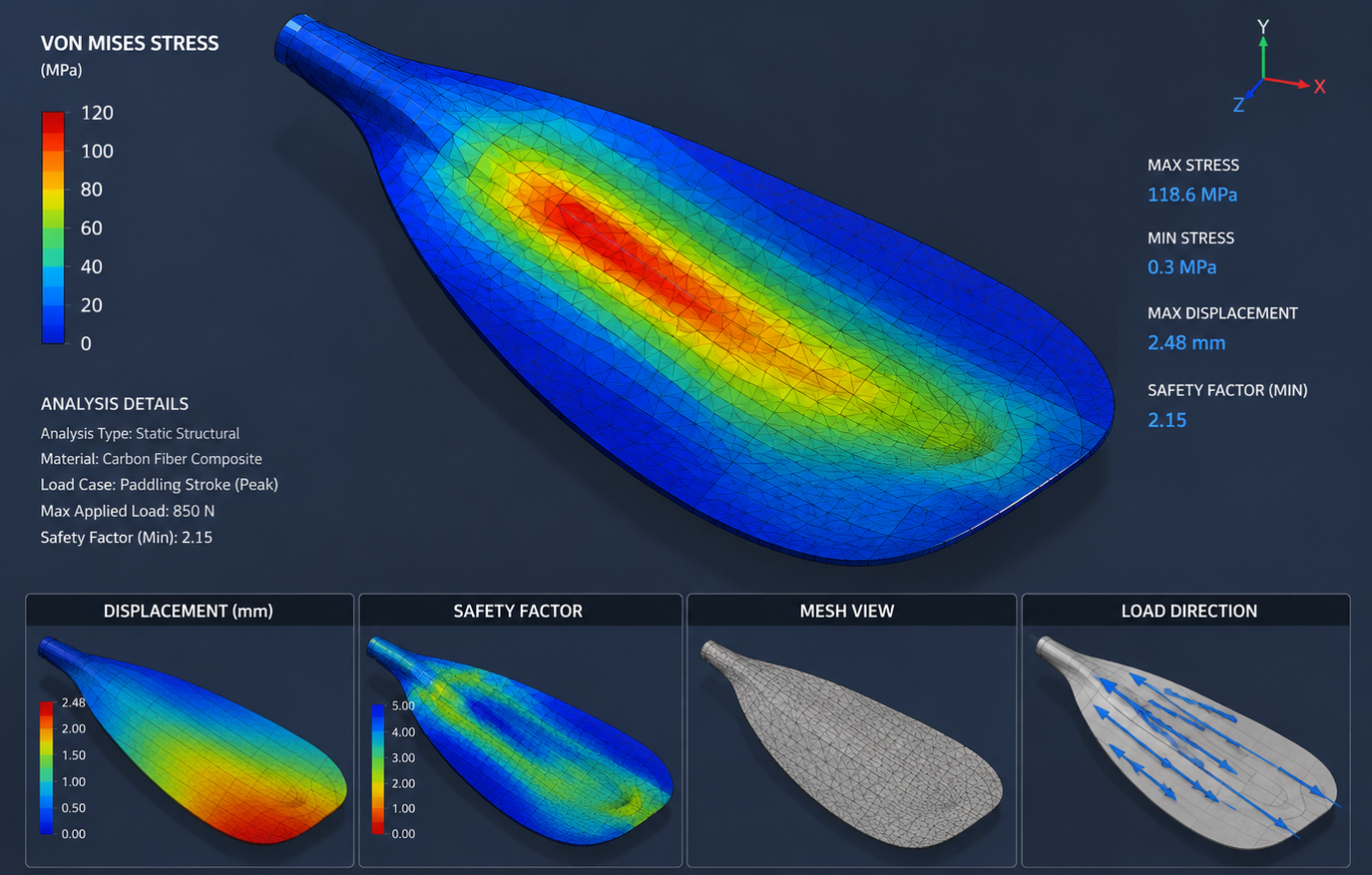
Andrew is the only SUP paddle manufacturer to have achieved this in carbon. The structural challenge of incorporating a crank into a carbon shaft without introducing weakness at the bend is considerable, and no one else has solved it. The geometry was validated using Finite Element Analysis, confirming that the design distributes load away from the bend point rather than concentrating it there. This isn't a simple modification — it's an engineering achievement in service of making you a better, more comfortable, less injury-prone paddler.
Andrew's industrial design training was rooted in ergonomics from the start: his student work at Ealing included designs shortlisted by the Royal Society of Arts for understanding how bodies work under load. The crankshaft is that same thinking applied to paddling, forty years on.
The Bottom Line
Every element of the Di Hedral exists to make you a more efficient, more comfortable, more capable paddler. Zero flutter, so your energy goes forward. A knife-edge catch, so none of your power is wasted at entry. A construction method that delivers stiffness an autoclave can't match. Innegra edges that last. A unified flex that reduces fatigue across a long session. And a crankshaft that protects your wrists, forearms and shoulders while unlocking the blade size your performance deserves.
Designed in 1987. Still ahead of the competition.